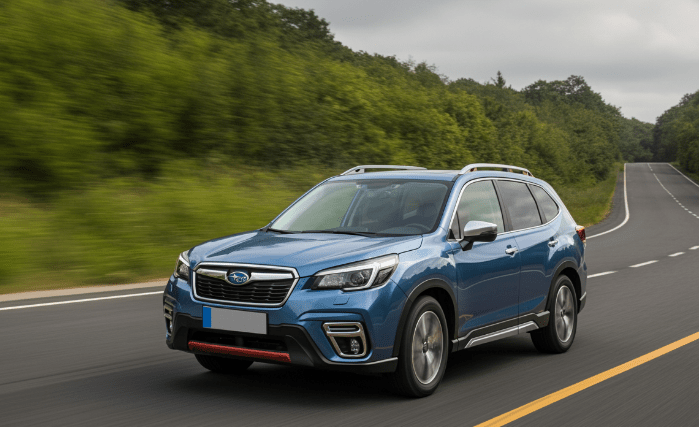
The 2025 Subaru Forester Hybrid is a significant addition to Subaru’s lineup, particularly for those who value off-road capability combined with improved efficiency. Subaru has designed this hybrid SUV to retain its rugged, adventure-ready identity while incorporating a hybrid powertrain that enhances performance and fuel economy. Below is a detailed breakdown of how the 2025 Forester Hybrid enhances its off-road capabilities and overall appeal.
Hybrid System and Powertrain Design
The 2025 Subaru Forester Hybrid employs a carefully engineered hybrid system that integrates seamlessly with its symmetrical all-wheel-drive (AWD) system, which is a hallmark of Subaru vehicles. The hybrid powertrain consists of:
- Engine and Electric Motors: A 2.5-liter flat-four engine running on the Atkinson-Miller combustion cycle is paired with two motor-generator units (MGUs). One motor acts as a starter and generator for charging the lithium-ion battery, while the second motor provides traction power to the wheels.
- Power Output: The combined system delivers 194 horsepower, which is an improvement over the gas-only model’s 180 horsepower. While the increase in horsepower may seem modest, the instant torque provided by the electric motors significantly improves responsiveness during off-road driving.
- Battery Placement: The lithium-ion battery (1.1 kWh capacity) is located under the trunk floor, ensuring no cabin space is compromised. However, this placement eliminates the spare tire, replaced by a tire repair kit.
This hybrid setup allows for smoother power delivery and better low-speed control—critical factors when navigating uneven or challenging terrains.
Off-Road Capability Features
Subaru has ensured that the Forester Hybrid retains its off-road prowess despite being equipped with hybrid components:
- Symmetrical AWD System: Unlike competitors like the Toyota RAV4 Hybrid or Honda CR-V Hybrid that use electric rear motors for AWD functionality, Subaru maintains its mechanical AWD system with front, rear, and center differentials. This design ensures constant power distribution to all four wheels for optimal traction on slippery or uneven surfaces.
- Ground Clearance: The Forester Hybrid offers an impressive 8.7 inches of ground clearance—the same as its gas-powered counterpart—making it suitable for tackling rugged trails and obstacles.
- X-Mode Technology: X-Mode optimizes engine output and transmission settings for various off-road conditions such as snow, mud, or gravel. It also includes Hill Descent Control to maintain stability on steep declines.
- Approach and Departure Angles:
- Approach angle: 19 degrees
- Departure angle: 24.6 degrees (24.7 degrees for Sport and Touring trims)
- Breakover angle: Slightly reduced to 19.3 degrees due to added weight from hybrid components but still sufficient for moderate off-road challenges.
These features ensure that even in hybrid form, the Forester remains one of the most capable compact SUVs in its class when venturing off paved roads.
Performance on Off-Road Terrain
During testing on forested trails in California’s Hollister Hills Off-Highway Vehicle Park:
- The Forester Hybrid demonstrated excellent stability on loose gravel surfaces thanks to its AWD system.
- It handled moderate ascents and descents effortlessly using X-Mode’s optimized settings.
- Compared to competitors like the Toyota RAV4 Hybrid and Honda CR-V Hybrid:
- The RAV4 struggled slightly with power vectoring during steep climbs.
- The CR-V failed entirely on certain inclines where traction was critical.
- The Forester climbed confidently without hesitation or loss of grip.
Subaru’s decision to prioritize mechanical AWD over electric-based systems gives it an edge in real-world off-road scenarios.
On-Road Refinement Supporting Adventure
While primarily designed for adventure seekers, the Forester Hybrid also excels in daily driving situations:
- Smoother Power Delivery: Electric motors provide instant torque at lower speeds, making acceleration smoother compared to gas-only models.
- Brake Pedal Feel: Regenerative braking transitions seamlessly into friction braking without noticeable interruptions—a common issue in many hybrids.
- Noise Reduction: Additional insulation around the transmission tunnel reduces cabin noise during highway cruising or heavy throttle inputs.
These refinements make long road trips more comfortable while maintaining readiness for spontaneous outdoor adventures.
Fuel Economy vs Competitors
Although not class-leading in fuel efficiency compared to rivals like Toyota RAV4 Hybrid (39 mpg combined) or Honda CR-V Hybrid (37 mpg combined), the Forester Hybrid achieves respectable numbers:
- EPA-estimated ratings:
- City: 35 mpg
- Highway: 34 mpg
- Combined: 35 mpg
Its larger fuel tank (16.6 gallons) provides an extended driving range of approximately 581 miles—outperforming both RAV4 (536 miles) and CR-V (518 miles).
Subaru fans are likely willing to accept slightly lower efficiency in exchange for superior AWD performance and ruggedness.
Interior Practicality
The interior remains spacious and practical despite housing hybrid components:
- Cargo space remains unchanged due to clever battery placement under the trunk floor.
- Visibility is excellent thanks to large windows—a signature feature of Subaru SUVs.
- Standard safety features include adaptive cruise control with lane centering assist, enhancing confidence during long drives.
Pricing & Value Proposition
The price premium for upgrading from a gas-powered Forester to a hybrid model ranges between $1,400–$3,185 depending on trim level:
- Starting price: $36,415 (Premium trim)
- Top-tier Touring trim price: $43,115
While slightly more expensive than competitors like Toyota RAV4 Hybrid ($33,500 base), buyers gain unmatched off-road capability alongside improved refinement—making it worth considering for adventure enthusiasts.
Recap
The 2025 Subaru Forester Hybrid successfully enhances adventure-ready off-road capability by combining traditional Subaru strengths—such as symmetrical AWD and high ground clearance—with modern hybrid technology that improves performance and efficiency without compromising ruggedness or practicality.
 Autos Magazine
Leave a comment